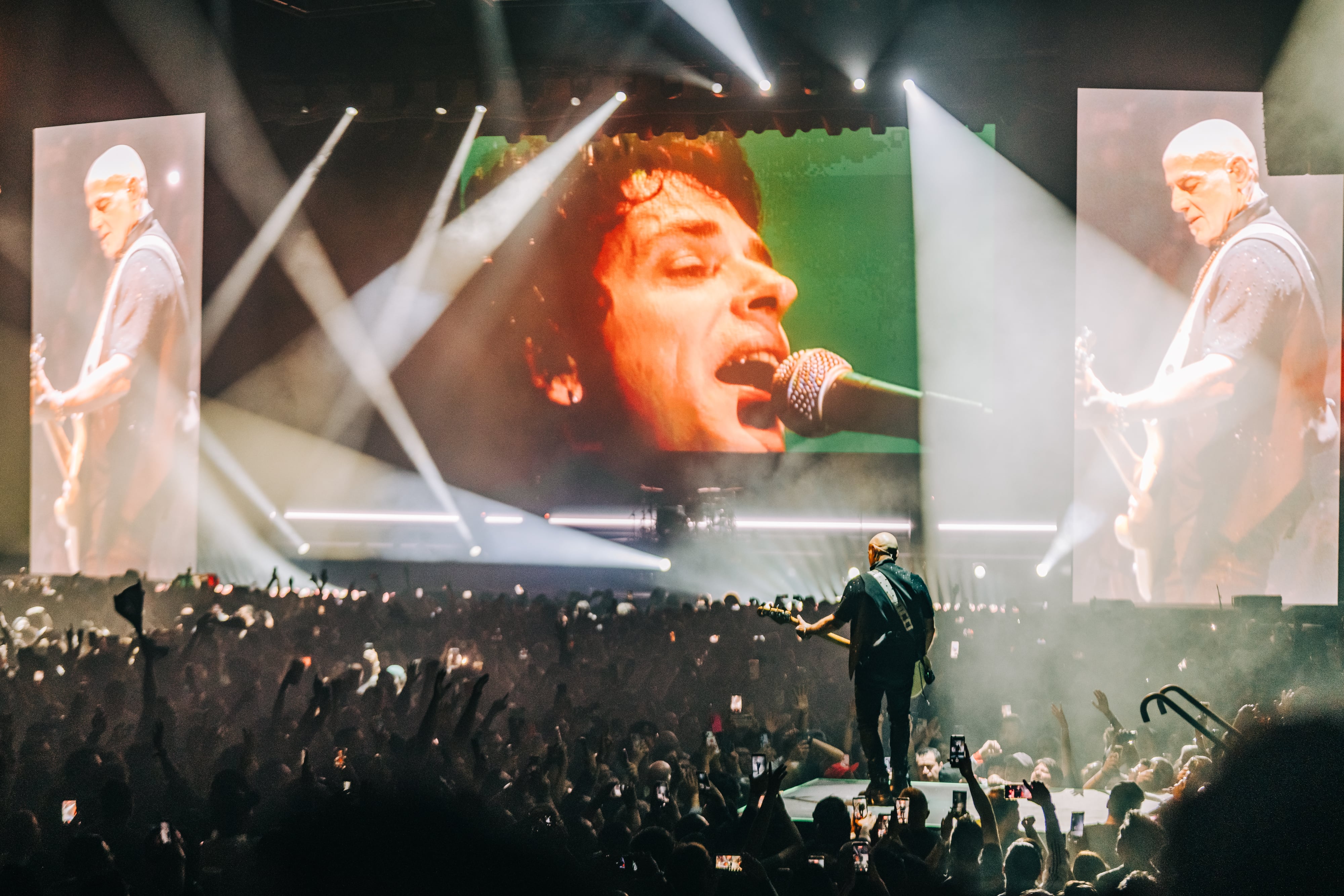
When technology surpasses man, is there room for humanity in art? What can we call real and what a lie? Yesterday, direct from Buenos Aires, the eighties rock band Soda Stereo landed in Madrid. A group that, after 30 years of their last tour, decided to get together and celebrate their music. The only downside is that Gustavo Cerati, the lead singer, passed away in 2014. But there he was last night, his face, his voice, his presence, celebrating life from beyond. And it is not a metaphor, a very sophisticated hologram planted the figure of the Argentine under the roof of the Movistar Arena. The Ecos tour has brought together Soda Stereo's biggest hits in a single night – it is also difficult to compose new songs when the voice we heard last night was recorded from the band's last concerts back in 1997, the only real thing was the bass and drums with an impressive wasted virtuosity – and the enthusiasm that the audience felt before entering seemed to be diluted with the first songs. 'Echoes' and 'Games of seduction' opened the strange concert and set the tone with an impressive play of lights and visuals projected on the screens; With 'When the tremor passes' and 'Zero Spring' we tried to create a 3D show that ended up being enjoyed more without the glasses than with them on. Between t-shirts of the Argentine national team, the Boca Juniors soccer club and completely black outfits, the public that came to the Movistar Arena was gradually connecting with the music that was playing. One of the best qualities of the human being is our ability to adapt, and after putting aside prejudices – if you managed to forget that you were listening to a dead person – the fans were encouraged by their favorite songs: 'In the city of fury' Madrid saw for the first time all night the Argentine rage when singing an anthem; 'TV Overdose' made even the most timid stands dance; 'American Blind' and 'Among Cannibals' reminded those present that they are alive and that they can enjoy the moment. Although everything is said, with one of the band's biggest hits, 'On the Seventh Day', we discovered that the euphoria could not be measured with the screams but with the cell phones that recorded the first seconds of the song - although what they recorded was a hologram preserved in time and his two companions in adventures much older than the fake singer. One of the virtues of this type of concert is being able to enjoy impressive music that you never thought you would see live, but the feeling of mixed feelings did not allow you to connect as much as possible with the band. It is always a pleasure to discover new music, even if they are classics with 40 years behind them. What is not so pleasant is to think that, in songs like 'Zoom' and the aforementioned 'When the tremor passes', the musicians were not even on stage and, even so, everything continued to sound exactly the same. But then, where is the humanity that gives life to the live shows? Those who were on stage were Zeta Bosio (bassist) and Charly Alberti (drums). The other two founding members of Soda Stereo spoke little during the hour and a half that the concert lasted, they only did so to remember how nice it is to "reconnect with your roots" and to be grateful that coming to "Madrid is like playing at home." Shortly afterward they performed 'Of light music', their most famous song, with which they said goodbye in style, now, with the entire Madrid temple standing chanting that "from that love / of light music / nothing frees us / nothing else remains."
Soda Stereo in Madrid, overshadowed by the specter of its vocalist
When technology surpasses man, is there room for humanity in art? What can we call real and what a lie? Yesterday, direct from Buenos Aires,…